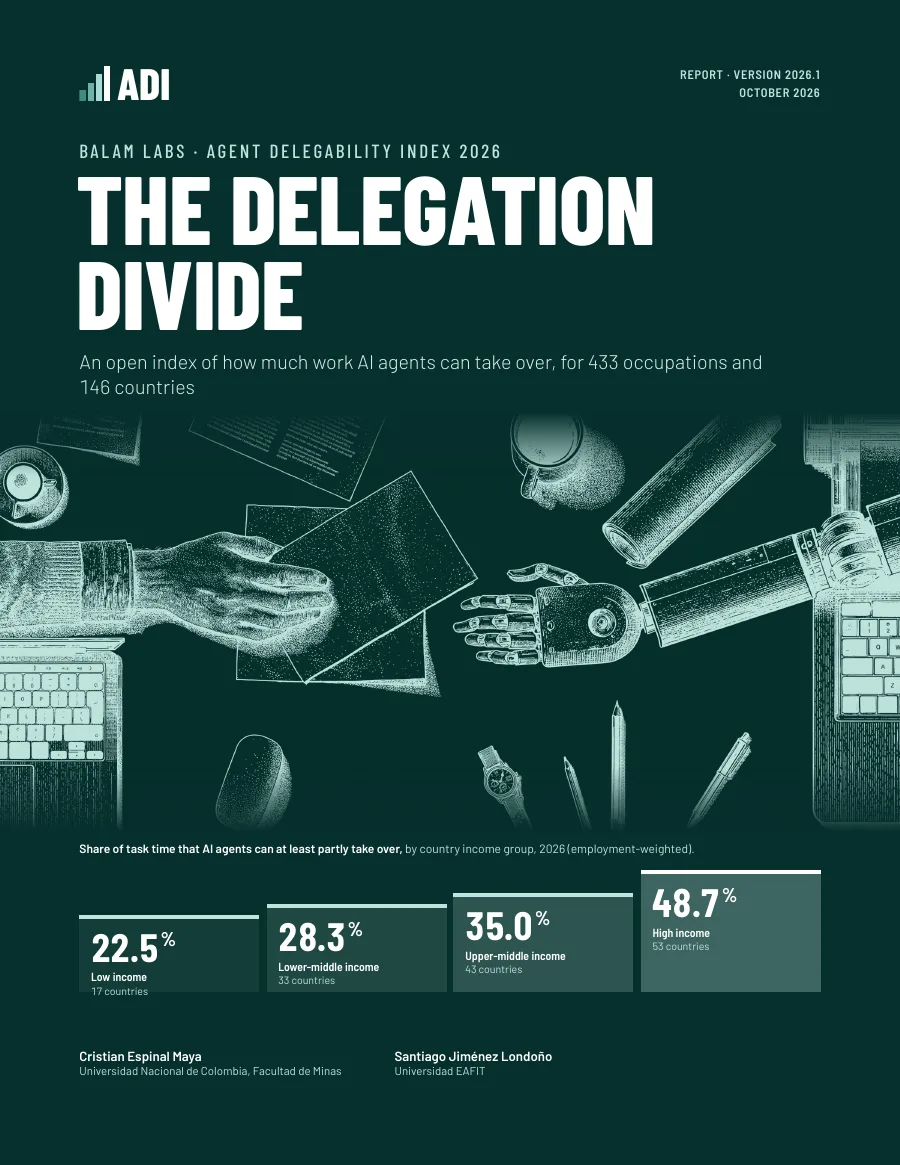
The Delegation Divide
An Open Index of AI-Agent Delegability across Occupations and Countries
- Cristian Espinal MayaUniversidad Nacional de Colombia, Facultad de MinasORCID 0009-0000-1009-8388
- Santiago Jiménez LondoñoUniversidad EAFITORCID 0009-0007-9862-7133
35.2% of task time in world employment is at least partly delegable to AI agents in 2026, and only 2.5% can be handed over in full. The Agent Delegability Index rates all 18,796 O*NET task statements on a frozen, preregistered rubric of delegation levels and barriers, maps them to 433 ISCO-08 occupations and weights them by employment in 146 countries. Delegable work rises with income, from 22.5% in low-income to 48.7% in high-income countries, because the physical barrier dominates the jobs poorer countries employ most. Full delegation peaks for tasks that take a person about 11.8 minutes. A blind human rating of 300 tasks agrees with the models at κ = 0.85.
The report is written for policy and general readers. The peer-review version is the paper, The Delegation Divide: An Open Index of AI-Agent Delegability across Occupations and Countries, with the same data and numbers; every figure in both is drawn from one file of claims checked against the published outputs.
About a third of the world’s working time is at least partly delegable to AI agents. 35.2% of task time in world employment (95% interval 33.9–36.7%), across 2,336.3 million workers.
Full delegation is rare. Only 2.5% of task time can be handed over in full. Partial delegation is the most common rating of a task (47.6% of statements).
Delegable work rises with income: the delegation divide. From 22.5% in low-income countries to 48.7% in high-income countries, 7.23 points per log point of GDP per capita.
The divide comes from what people do, not from where they do it. The physical barrier is flagged on 94.1% of task weight in elementary occupations against 21.3% for managers.
Office work is the most delegable. Managers reach 81.8% and clerical support workers 78.3%; elementary occupations 12.3%.
Countries range from Burundi to Singapore. From 14.7% to 64.2%. Colombia 38.3%, Mexico 36.8%, Brazil 39.9%, the United States 51.9%.
Delegation tracks exposure, and adds levels and barriers to it. r = 0.93 with Eloundou et al. and 0.89 with Felten et al., above the preregistered bound of 0.80.
Full delegation peaks for tasks of about twelve minutes. The chance that an agent finishes a task alone rises with its length up to about 11.8 minutes of human time and falls after it.
Use follows delegability. Across 101 countries, observed AI use correlates with the index at r = 0.86. The preregistered adoption gap is not supported.
The ratings hold up against people and agents. Models agree at κ = 0.77; a blind human rating at κ = 0.85; an agentic panel with web search at κ = 0.87.
Part I · Measuring delegation
- 1 From exposure to delegation
- 2 Data
- 3 Method
Part II · The delegation divide
- 4 The index
- 5 The atlas: a delegation divide
Part III · Testing the index
- 6 Validation, convergence and adoption
- 7 Limitations and ethics
- 8 Conclusion
Annexes
- A Scoring rubric
- B Crosswalk O*NET to ISCO-08
- C How to cite and use ADI
Espinal Maya, Cristian, and Santiago Jiménez Londoño. 2026. The Delegation Divide: An Open Index of AI-Agent Delegability across Occupations and Countries. ADI Report 2026.1. Balam Labs. https://github.com/Cespial/delegation-divide
@techreport{espinal2026delegationreport,
  title       = {The Delegation Divide: An Open Index of AI-Agent Delegability across Occupations and Countries},
  author      = {Espinal Maya, Cristian and Jim{\'e}nez Londo{\~n}o, Santiago},
  institution = {Balam Labs},
  type        = {ADI Report},
  number      = {2026.1},
  year        = {2026},
  url         = {https://github.com/Cespial/delegation-divide}
}Text and figures: CC BY 4.0. Data: CC BY 4.0, doi:10.5281/zenodo.23552918. Code: MIT, GitHub. Preregistration: doi:10.17605/OSF.IO/9ZNTF.
To cite a single occupation or country, use the citation on its page; it names the record and the dataset version.